



CNC Turning
CNC Turning is a subtractive manufacturing process, where material is gradually removed from a larger billet of stock, using a cutting tool to reveal the desired final workpiece. CNC turning differs from manual lathe turning by the incorporation of a computer controller, allowing automation of the part cutting and production process. Automation improves the accuracy, precision, repeatability, and throughput of the machine tool compared to manual machining methods.
Corpus Techna Services
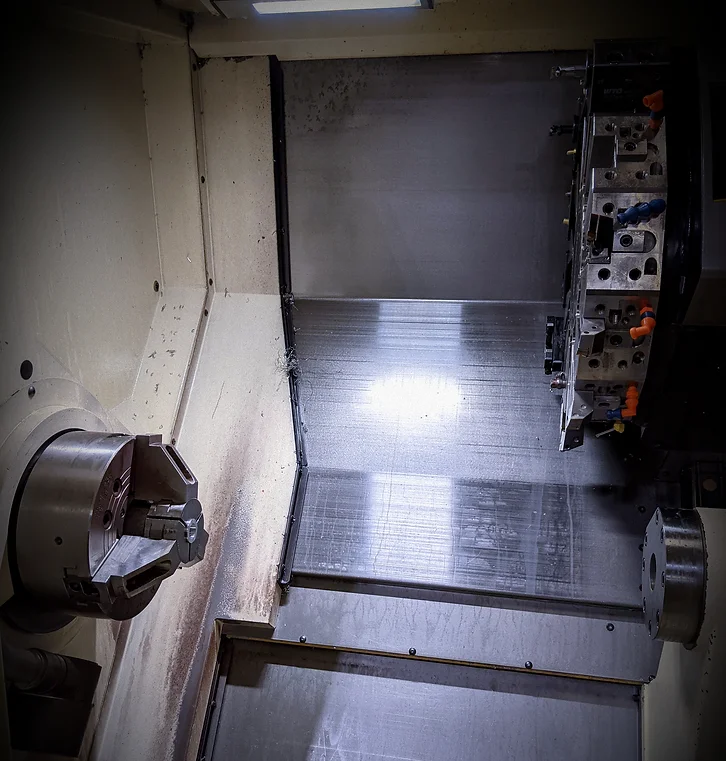
Standard Turning
Lathes are used to machine parts that have a radial symmetry about a revolved axis, such as round or cylindrical features. Lathes can also be used to cut precision features into oddly shaped parts, by using custom or specialized jaws. These machine tools operate with 2 axes of machine travel, the Z-Axis controls the tool position along the axial length of the part; the X-axis is used to command the tool position radially to produce the desired diameters. Contours and threads can be produced by moving both machine axes simultaneously in synchronized motion.
2-axis Lathes are limited to producing holes and other internal features that are concentric to the axis of revolution only; however, complex internal features such as grooves, contours, and threads are within the capability of this type of machine tool.
A tailstock can be used to support the unchucked end of the workpiece, to reduce deflection and taper of the machined surface. This is generally required for long parts, very thin walls, or a slender shape. A good rule of thumb is parts with a length-diameter greater than 4:1 will require use of a tailstock.
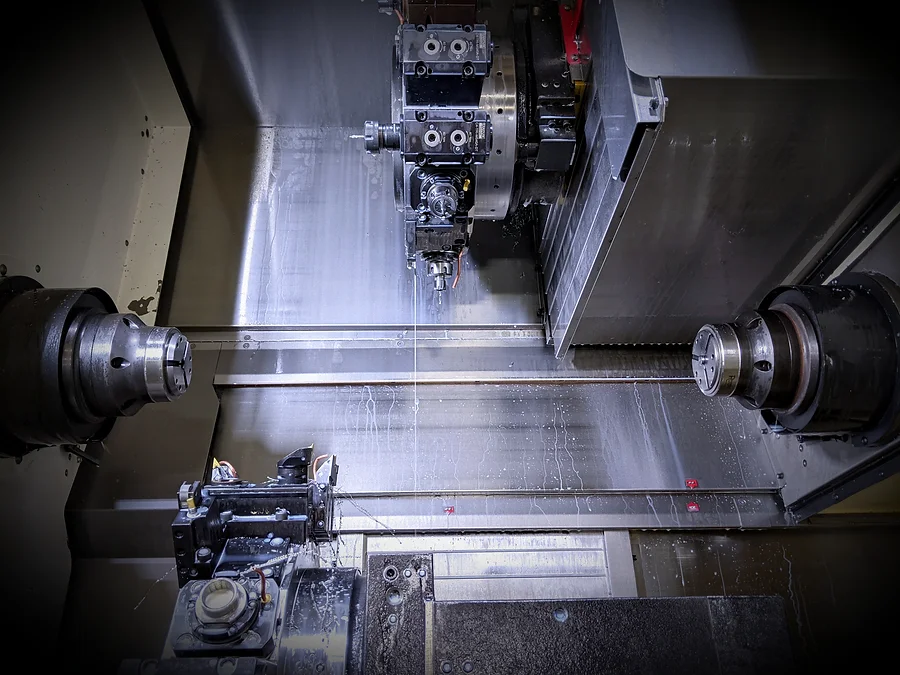
Advanced Turning
Lathes are used to machine parts that have a radial symmetry about a revolved axis, such as round or cylindrical features. Lathes can also be used to cut precision features into oddly shaped parts, by using custom or specialized jaws. These machine tools operate with 2 axes of machine travel, the Z-Axis controls the tool position along the axial length of the part; the X-axis is used to command the tool position radially to produce the desired diameters. Contours and threads can be produced by moving both machine axes simultaneously in synchronized motion.
2-axis Lathes are limited to producing holes and other internal features that are concentric to the axis of revolution only; however, complex internal features such as grooves, contours, and threads are within the capability of this type of machine tool.
A tailstock can be used to support the unchucked end of the workpiece, to reduce deflection and taper of the machined surface. This is generally required for long parts, very thin walls, or a slender shape. A good rule of thumb is parts with a length-diameter greater than 4:1 will require use of a tailstock.